

How many coats of paint on cabinets? Usually one coat of primer and two coats of paint. Dark or oak cabinets often need a stain-blocking primer, sometimes two coats of it, so the old color and the wood’s tannins don’t bleed through. Sprayed coats go on thinner, so a sprayed finish may get one more coat than a brushed one.
The spots that take the most wear, like the sink base and the bottom edges of doors, are worth an extra coat. More isn’t always better, though: too much paint builds up on edges and chips.
Here’s how we decide the count on our cabinet painting jobs, and how long to wait before you use them.
How Many Coats of Paint on Cabinets? We Count Primer and Paint Separately
Most answers to how many coats of paint on cabinets lump everything together as “two to three coats.” That hides the part that matters.
Primer and paint do different jobs. Primer makes the paint stick and blocks what’s underneath. Paint gives you the color and takes the daily wear. So we count them separately.
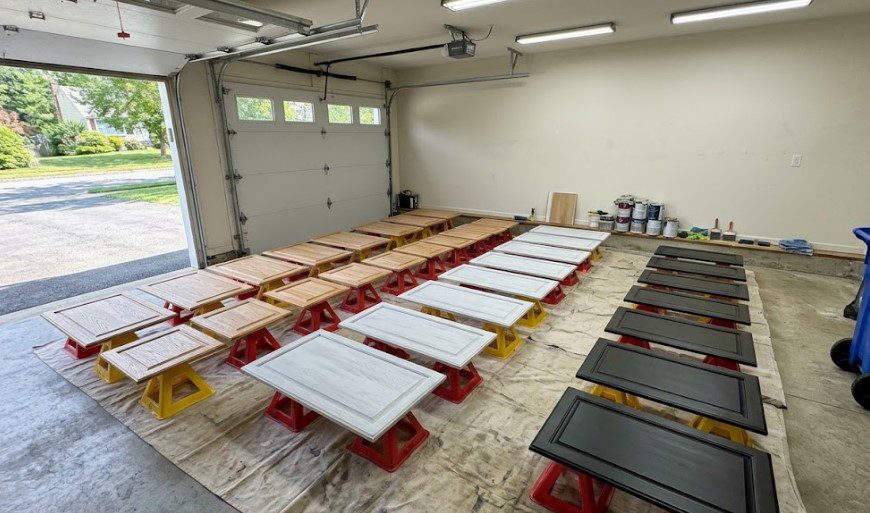
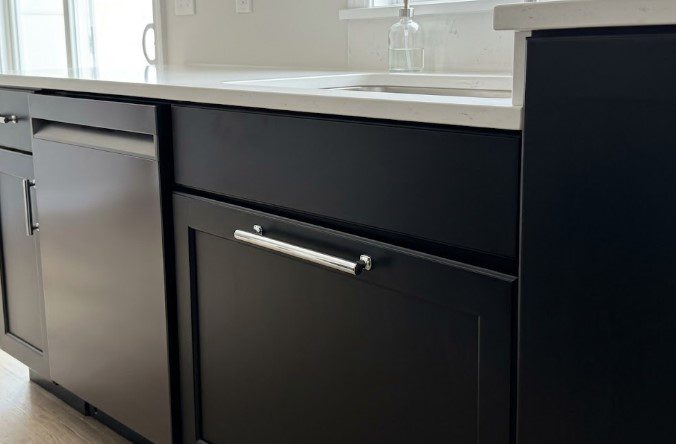
On a Paramus kitchen, the doors went from golden oak to Tricorn Black (SW 6258). They got 1 coat of Sherwin-Williams Extreme Bond Primer, then 2 coats of Sherwin-Williams Emerald Urethane Trim Enamel, sprayed, with an extra coat on the sink base and lower door edges. Because they were going black, tannin bleed wouldn’t show, so a bonding primer was the right call. Going white, we’d have used a stain blocker.
The doors went back up after 4 days, and the homeowners were cooking normally again the same evening, just going easy on the doors for the first couple of weeks while the enamel finished hardening.
You can see all three stages side by side above, laid out on stands so both faces could be worked without touching.
How Many Coats of Primer We Put on Cabinets
How many coats of primer on cabinets? One, on most cabinets that have been properly cleaned and sanded. Two when they’re dark-stained or oak, because those cabinets fight back.
Oak and dark wood contain tannins, natural compounds that can bleed up through light paint as yellow or brown blotches, sometimes weeks later. A stain-blocking primer locks them in.
On dark cabinets going light, a second coat of that primer is cheaper than a third coat of finish paint that still doesn’t hide the old color.
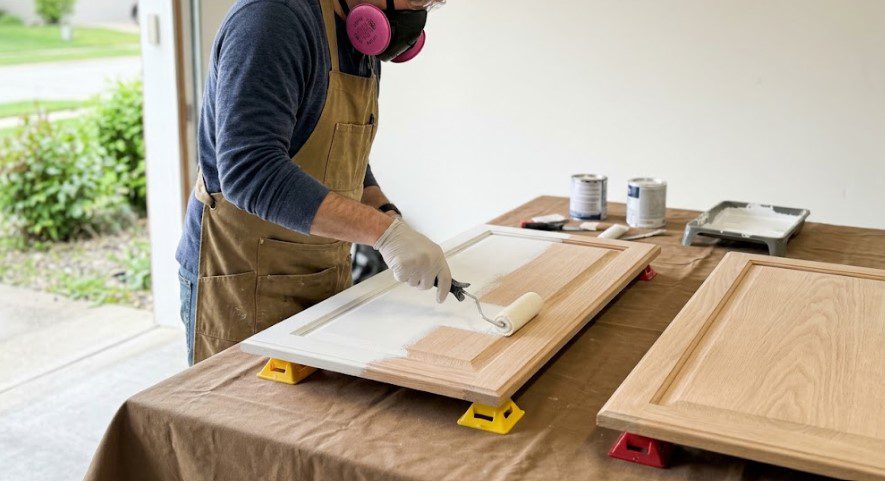
Oak also has open grain, and paint alone won’t hide it. If you want a smooth, modern look with no texture showing, the grain has to be filled before priming.
If you like the texture, we skip it. None of that primer holds without good cabinet prep first: degreasing, sanding and cleaning every surface.
Why Spraying Changes the Count
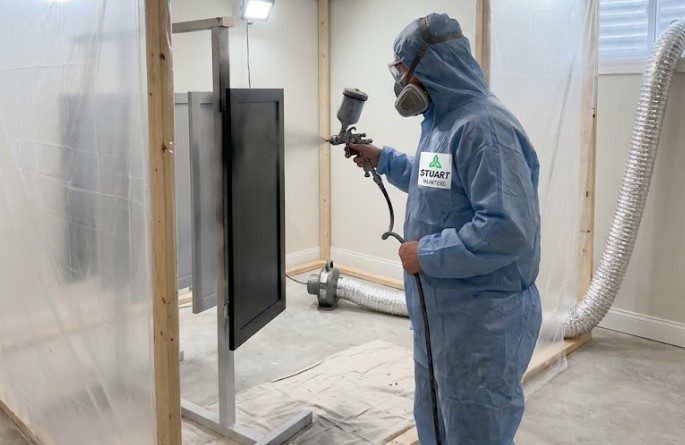
How the paint goes on changes how many coats it takes. A sprayer lays down a thin, even film with no brush marks, which is why sprayed cabinets look closest to a factory finish. Because each coat is thinner, it can take a third coat to build the same protection that two brushed coats give.
Brushed and rolled coats go on heavier, so two usually covers it, but they leave some texture, especially on raised-panel doors. Either can be done well. What matters is that the total film ends up thick enough to wear, without getting so thick that it causes problems of its own.
The Spots That Get an Extra Coat
A kitchen doesn’t wear evenly, so we don’t paint it as if it does. A few places take far more abuse than the rest, and they’re worth one more coat:
- The sink base. Drips, wet hands and the cleaning spray all land here, and the door bottom stays damp longer than anywhere else.
- Lower door edges. Feet, mop heads and the vacuum hit them every week.
- Around the pulls. Fingers find the same spot thousands of times a year, and skin oils wear paint faster than you’d think.
- The drawer under the cutlery and the trash pull-out. They’re opened more than any other drawer in the house.
Why More Coats Isn’t Always Better
It’s tempting to think a fourth or fifth coat makes cabinets tougher. Past a point, it does the opposite. Paint builds up thickest on the edges and in the corners of raised panels, where it stays softer longer and chips more easily once it does harden. Thick paint on the hinge side can make doors rub or stick against the frame, and drawers that used to glide can start to bind.
The goal is enough film to protect the wood and stand up to daily use, laid on in thin, even coats. Two good coats of a proper cabinet enamel over the right primer will outlast four rushed ones.
How Long We Wait Between Coats, and Before You Use Them
How long between coats of paint on cabinets comes down to the product and the room. With the enamel we use, we wait 4 hours between coats, and longer on a humid summer day or in a cool basement. Each coat gets a light sanding once it’s dry, so the next one bonds and lies flat.
There are really two waits, and people mix them up. The paint is dry when you can touch it. It’s cured when it has fully hardened and can take dishes, pots and wet hands without marking. That takes much longer.
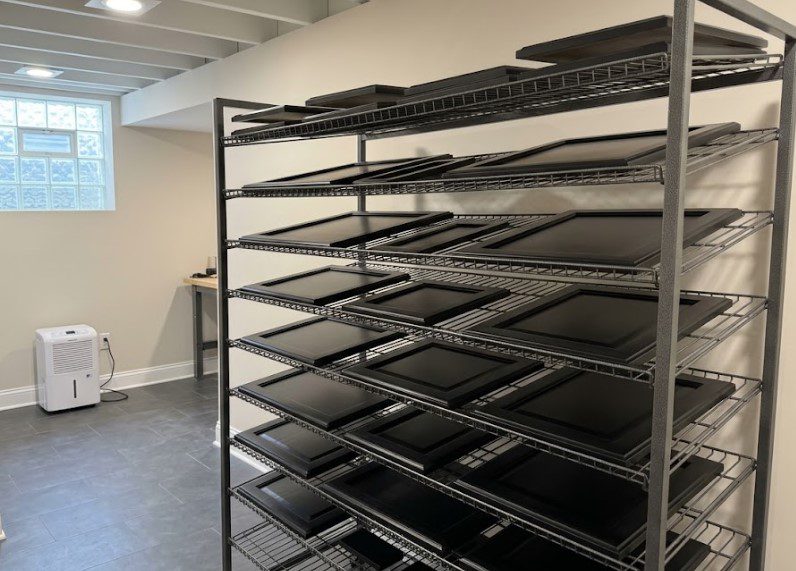
On our jobs, doors usually go back up after 3 to 4 days. For the first 2 to 3 weeks, close doors and drawers gently, skip stick-on bumpers, and wipe spills rather than scrubbing.
Questions We Hear About Painting Cabinets
Can you paint cabinets with one coat?
Not if you want them to last. One coat rarely hides the old finish evenly, and it’s too thin to stand up to daily use.
Do you need to sand between coats on cabinets?
Yes, lightly. A quick scuff with a fine sanding pad knocks down dust and gives the next coat something to grip.
What sheen is best for cabinets?
Satin or semi-gloss. Both wipe clean easily, and we usually match the trim if we’re doing interior painting at the same time.
Can you paint over laminate or thermofoil cabinets?
Laminate in good shape can be painted with a bonding primer after a scuff sanding. Thermofoil that’s already peeling or bubbling isn’t worth painting, because the film keeps lifting underneath.
Why are my painted cabinets sticky?
Usually the coats went on too thick, or too soon after the last one. Waiting long enough between coats, and giving the paint time to cure, prevents most of it.
Let Us Count the Coats for Your Kitchen
We’ll look at your cabinets, tell you what primer and how many coats they need, and put it in writing before we start. Ask for a free estimate. Every interior job, cabinets included, is backed by our 10-year workmanship warranty, and seniors, veterans and first responders save 10%.


